The benefits of Dry January, including the one nobody counts
Sleep is the one nearly everyone notices first. Energy follows. Skin and mood come later and more slowly than the internet suggests.
And underneath all of it there’s a number: whatever you’d normally spend on drinking in a month, sitting in your account instead. Almost nobody works it out.
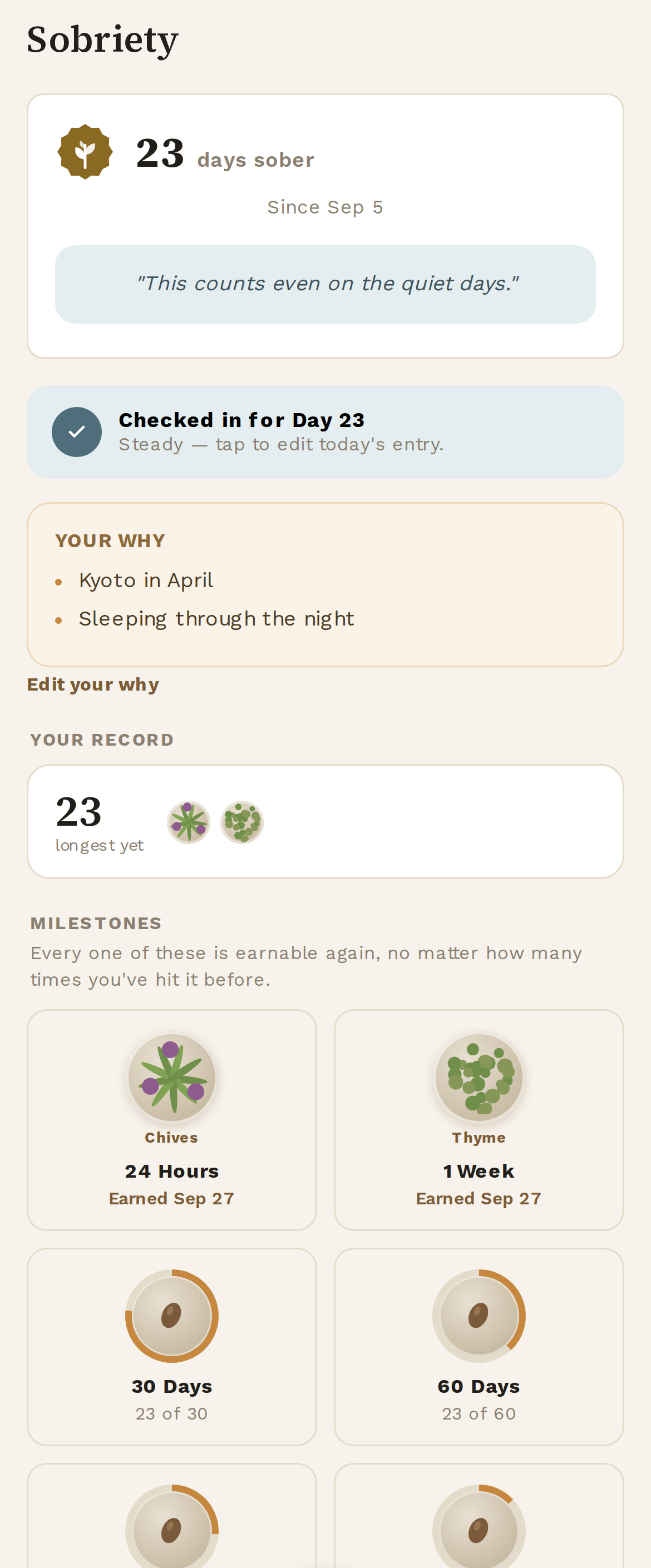
Addley tracks the month as a day count, keeps your history if you slip, and puts that money toward something you chose in advance. Free for this, permanently.
What people actually notice
The first week is often worse, not better. That catches people off guard. Sleep can be broken, you may be short-tempered, and somewhere around day four the whole thing can feel like a mistake.
Then it turns. Sleep is the change nearly everyone reports, and it’s usually the first real one — you stay under instead of surfacing at three in the morning. Energy follows from that rather than arriving separately.
Skin changes later and less dramatically than before-and-after photos imply. Mood is the complicated one: alcohol is a depressant, so most people do feel steadier eventually, but not immediately and not in a straight line.
All of which is real, and all of which has the same problem. By the middle of the month these have become background. You can’t point at them.
The one nobody counts
Every list of Dry January benefits has “save money” on it somewhere near the bottom, with no number attached. That’s the one worth doing properly, because it’s the only benefit on the list you can actually see.
Take what you’d normally spend in a month. Not just the drinks — the rounds you bought, the taxi because you couldn’t drive, the delivery at midnight, the Sunday you wrote off. Add it up honestly.
Most people have never done that sum. It’s usually bigger than they’d have guessed.
But knowing the number doesn’t do much on its own. It shows up in February as a vague sense of having spent less, and then it’s gone — absorbed into the month like everything else. What makes it count is deciding what it’s for before you start.
A trip. A coat. The thing you keep not buying.
That’s what Addley is built around. You pick the thing first, and every day you log moves real money toward it. On the 31st you’re not looking at a finished calendar. You’re looking at a total, next to a photo of what it’s for.
To be clear about the money: it’s yours, in your own account, and you move it yourself. Addley can show a linked savings balance next to the goal, read-only. It cannot move a penny, and nobody is paying you to show up.
Why it usually unravels anyway
Most people doing Dry January have done it before. That isn’t a failure, it’s just the shape of the thing — you get through a month, it goes fine, and by March it’s as though it never happened.
The hard part isn’t the first week. It’s day eleven, at someone’s birthday, when better sleep has stopped feeling like an achievement and saying “I’m doing Dry January” out loud sounds thinner than it did on the 1st.
Then there’s the other failure, the one nobody talks about: you slip on day twelve and quit entirely. Not because twelve days meant nothing, but because most apps respond by showing you a zero.
A streak only moves one way. The longer it gets, the more there is to lose, and one wedding can end it. A day count behaves differently — it’s a fact about you rather than something you’re guarding.
The twelve days counted.
In Addley you move the start date and carry on. The history stays, and anything you’d already reached stays reached. Worth checking in whatever app you pick, before the 1st rather than on day twelve.
When Addley isn’t the right pick
You want people around you. A lot of people get through this because someone else is doing it at the same time. There’s none of that in Addley today — challenges are solo. There will be eventually, and it will be anonymous, which means it still won’t be what a room of actual people is. If that’s the part that would carry you, find a group. You can do both.
You only want the one number. Addley holds thirteen practices and ties them to a savings goal. If all you want is a counter, a counter will do it with less setup.
You’re stopping for good. That’s a different thing, and it’s medical. No tracker is treatment, this one included. Talk to a doctor first — withdrawal from heavy drinking can be dangerous.
Questions
Pick the thing before the 1st
Five minutes now — decide what the month is paying for, start the challenge — is the difference between doing this and meaning to.
Free in your browser. No card.